
 Apply
Apply  Visit
Visit  Request Info
  Give
Give  Apply
Apply  Visit
Visit  Request Info
  Give
Give  D2L
D2L  Calendar
  Directory
  Course Schedule




 About Us
Strategic planning drives our vision, linking ambition with action. We build a vibrant community by seizing opportunities and preparing for challenges.
Promise Plan
Saint Paul College has launched Our Promise Plan, a strategic framework built around Purpose, People, and Place. Building on the success of Creating a Stronger Future 2025, this plan reimagines the role of a community college in today’s world. Informed by campus-wide collaboration and our work with Education Design Lab, it reflects the voices of students, employees, and partners. This plan will guide our work until 2030.

Transformative Innovations
At Saint Paul College, transformative innovation means turning ideas into action. Through new programs, partnerships, and learner-centered models, we are creating solutions that strengthen student success, respond to workforce needs, and expand our impact across the community. These initiatives help bring Our Promise Plan to life and position the college for the future.
Connecting the dots
Our mission, vision, and values fuel the strategies we develop. These strategies allow us to relentlessly pursue our goals and uphold our commitment to racial equity, vibrant communities, and thriving economies.
Annual planning
Budget planning
Past strategic plan
Creating a Stronger Future 2025 (CSF2025) was a three-year plan that leverages our century-long dedication to delivering quality education to our community. This plan ended in Summer 2025 as we began launching our work with Education Design Lab.
The Promise Plan
The Promise Plan is Saint Paul College’s strategic plan to guide transformation from 2026 to 2030. Built on three pillars of promise, Purpose, People, and Place, the plan outlines how the college will grow, adapt, and continue placing student success at the heart of everything we do.
In a time of transformation across higher education, this framework helps us remain responsive, inclusive, and future-focused.

 Our Promises
  Goals & Initiatives
  Plan Documents
 Our Promises

Purpose
We’re exploring ways to redesign education across credit and non- credit pathways to make skills more visible, relevant, and career- connected. This could mean creating or modifying programs that better align with workforce needs and empower students to pursue meaningful careers.

People
We’re building an inclusive culture where innovation thrives, and employees are empowered to enhance the campus experience. This commitment encourages collaboration, and supports one another in our work. As a learning organization, we create opportunities for students to embrace experimentation, knowing that failure fuels growth—and that progress often begins with trying something new.

Place
We’re committing to Saint Paul College’s role as an anchor institution that advocates for equity and works to eliminate socioeconomic barriers to student success. This commitment involves being a positive force in our community and ensuring that every learner has the opportunity to thrive, whether through our support or by connecting students to community resources.
Goals & Strategic Initiatives
Promise #1
Purpose
Goal 1.1
By 2030, redesign the student experience to ensure all learners can identify and communicate the skills they gain—while navigating personalized, stackable learning pathways that connect their education to purpose, opportunity, and meaningful careers through coursework, co-curriculars, and applied learning.
Strategic Initiatives:
- Help students identify and articulate the skills and competencies they are developing in their educational and life journey
- Implement and adopt digital tools that help students track, reflect on, and communicate their learning and skill development
- Provide all students with an opportunity to participate in an applied learning opportunity
- Strengthen alignment between academic programs and labor market needs
- Design and promote personalized stackable credential pathways
- Enhance advising, career services, and student support to provide personalized, timely guidance that links academics to meaningful career, transfer, and life opportunities by improving the quality, accessibility, and integration of these services
Promise #2
People
Goal 2.1 [Employee-Focused]
Cultivate a bold and inclusive college culture where innovation thrives, challenges fuel learning, and every employee is empowered to proactively advance student success and enrich campus interactions for all.

Strategic Initiatives
- Cultivate a workplace where people feel valued and supported through inclusive organizational practices that expand agency and fuel collaborative innovation
- Foster employee creativity and inclusion by creating structures that enable idea generation, testing, and improvements for students.
- Build equitable practices that strengthen belonging for all employees.
GOAL 2.2 [Student- Focused]
Cultivate a bold and inclusive college culture that prepares every student to shape their own success, fostering courageous thinking, embracing setbacks as learning opportunities, and embedding equity, belonging, and innovation into every aspect of the student success pathway.
Strategic Initiatives
- Expand opportunities for students to co-design programs and activities, ensuring their voices actively shape campus initiatives.
- Enhance learning environments, student engagement practices, and campus culture to intentionally cultivate belonging, agency, and innovation throughout the student success pathway
- Expand and integrate high-impact learning experiences across the institution to increase student access to meaningful, real-world learning opportunities.
- Integrate resilience-focused practices into the academic and co-curricular to help students normalize setbacks, analyze challenges, and persist.
Promise #3
Place
GOAL 3.1
Demonstrate the role Saint Paul College plays in advancing equity and upward mobility through relevant, visible, and community-centered change.

Strategic Initiatives
- Increase SPC’s visibility through mission-aligned advocacy and data-informed leadership that promotes student success and workforce opportunities.
- Expand cross-sector partnerships and strengthen community coalitions through shared goals, coordinated initiatives, and continuous partner feedback.
- Strengthen place-based initiatives that drive economic equity for underserved communities.
GOAL 3.2
Mitigate the impact of unmet basic needs through advocacy, education, and resource navigation.
Strategic Initiatives
- Strengthen student momentum and academic persistence for learners facing basic needs insecurity through proactive, equity‑centered supports and early outreach
- Improve student satisfaction with the availability, accessibility, and responsiveness of basic needs‑ services (capacity expansion)
- Increase the college’s ability to serve students through coordinated basic needs supports (experience, quality, and capacity)
- Enhance trauma-informed case management processes to shorten response and resolution times for urgent student support referrals. (urgency, response, stability)
- Standardize and increase college-wide use of EAB Navigate to coordinate referrals and student support across departments. (platform and data system)
- Expand coordinated use of EAB Navigate across academic and student support units to improve cross-departmental referrals (people and behaviors)
Promise Plan Documents & Resources
The documents below provide additional context for how Our Promise Plan was introduced, shared, and discussed across campus. These materials are referenced in Campus Bridge and campus‑wide conversations and are offered here as a shared resource.

Campus Bridge: Introducing Our Promise Plan (August 14, 2025)
This Campus Bridge issue marked the formal introduction of the Promise Plan framework to campus, outlining its origins, core pillars, and why this work matters now.

Our Promise Plan: Introductory Slides
These slides provide a high‑level overview of the Promise Plan, including the three pillars—Purpose, People, and Place—and the long‑term goals guiding our work through 2030.

What to Expect
Over the next five years, we’ll be deeply engaged in a process of innovation and redesign. We’ll be working together to build a Saint Paul College that is even more responsive to the needs of our students and community, while strengthening our ability to adapt to the evolving demands of the workforce.

Who’s Involved
This is a collaborative effort involving not only our internal community but also external partners. We’ll be working closely with Education Design Lab, whose expertise in human-centered design and community college innovation will be invaluable. We’ll also be collaborating with other community colleges across the nation, sharing best practices and learning from each other’s experiences.

Why It Matters
This initiative will help Saint Paul College enhance student success by creating clearer pathways and providing relevant learning experiences. It will also strengthen our community by ensuring the college remains a vital resource for students and employers. By participating in this national initiative, we will be at the forefront of innovation in community college education.
Our Timeline
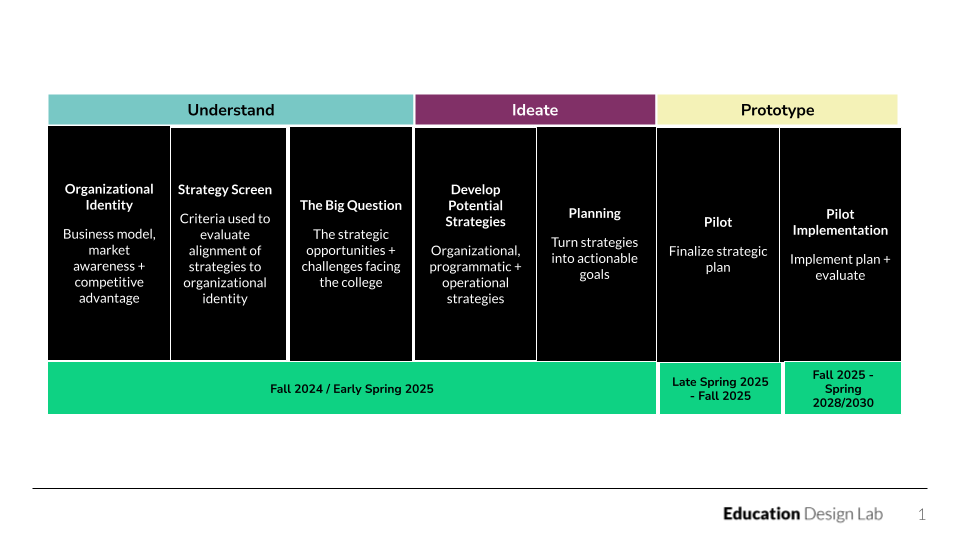
This timeline provides a roadmap for the Reimagining Community Colleges Design Challenge, guiding stakeholders through a structured process to create a new strategic plan that will drive sustainable and equitable solutions for Saint Paul College.
Operating Framework
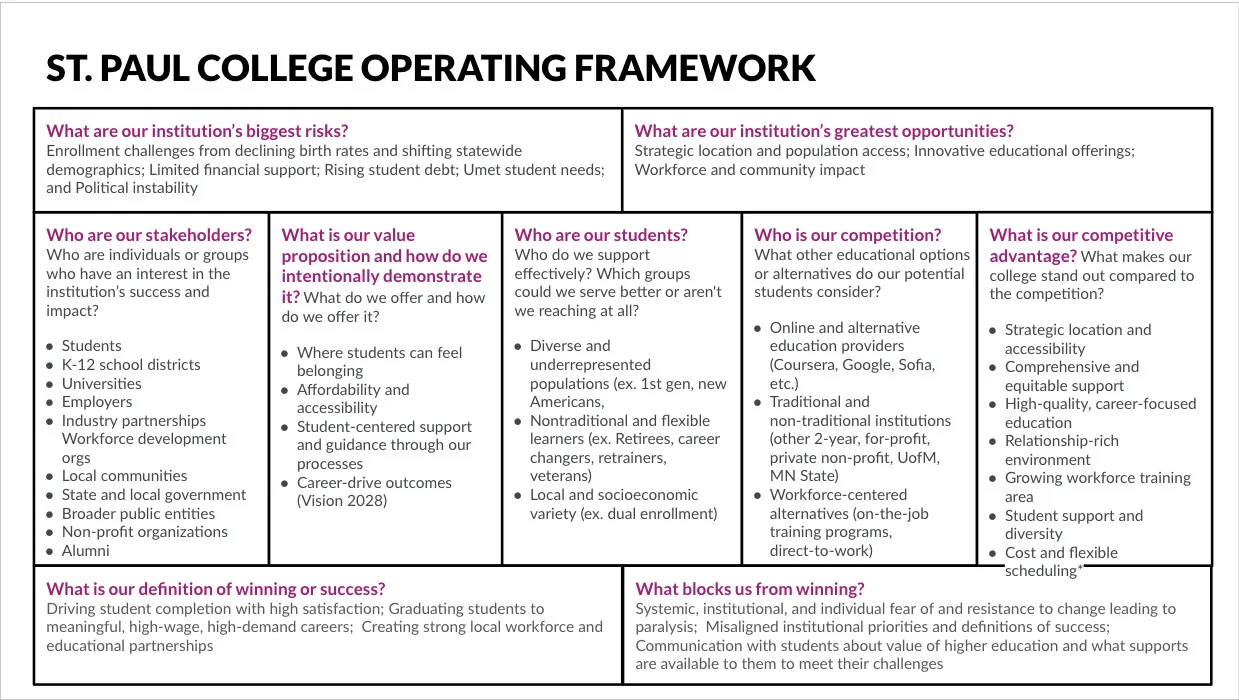
Our Operating Framework allows us to assess our institution’s risks, opportunities, stakeholders, definitions of success, barriers to achieving that success, and more.

How might Saint Paul College deepen its community impact in Saint Paul as a trusted anchor college by supporting and empowering students to become engaged community members with the skills needed to provide lifelong economic stability?
Saint Paul College
Previous Strategic Plan
Creating a Stronger Future 2025
Launched in September 2022 after a year-long collaborative effort involving various stakeholders, Creating a Stronger Future 2025 (CSF2025) is a three-year plan that leverages our century-long dedication to delivering quality education to our community. Positioned to adapt to the dynamic demands of today’s workforce, this strategic plan is imbued with our commitment to anti-racism and trauma-informed practices. CSF2025 outlines four strategic directions to chart the College’s course to 2025.

Creating a Stronger Future 2025
Uncover the beginnings of our strategic plan, Creating a Stronger Future 2025 (CSF2025), through this news story that captures the excitement and collaborative effort that marked its launch in September 2022.


Story Map of the Plan
Navigate through the strategic landscape of CSF2025 with our interactive StoryMap. This visual guide provides a comprehensive overview of the plan’s key elements, strategic directions, and the trajectory it sets for our college’s future.

Annual Progress Report
Delve into the details of our achievements, strategies, and the impactful changes we aspire to make by reviewing our 2023 Annual Progress Report

Mission Alignment
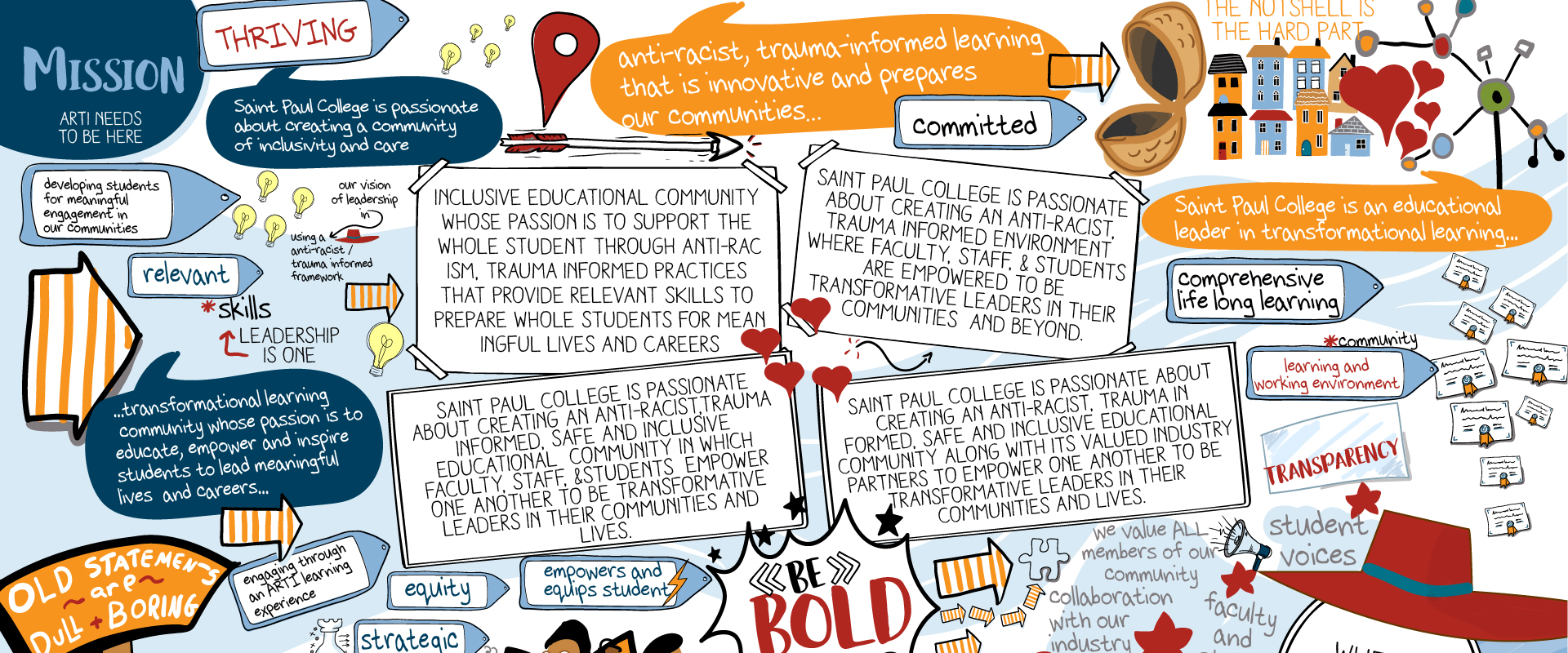
Planning, in all its forms, is the vehicle through which we transform our mission from aspiration to reality. By carefully crafting and executing strategic, operational, and tactical plans, we ensure that every action we take directly contributes to fulfilling our mission.
Annual Planning

Annual Planning enables each department to set objectives, outline actionable tasks, and demonstrate how they support College goals. It justifies budget requests and aligns allocations with strategic priorities.
Budget Planning
The annual operating budget at Saint Paul College is a monetary plan aligned with Board policies and system procedures. The Finance Department aims to support the College’s mission through a budget process that secures long-term financial health.

Current Financial Outlook
The College’s current financial position (FY27) is strong, with a balanced budget and stable operations. Looking ahead, uncertainty in state funding and growing expenses may create new challenges that require thoughtful planning and strategic decision-making.

Planning Principles
The College will make planning, budgeting, and decisions based on a commitment to the College’s planning principles.

State Resources
The Minnesota State Financial Planning and Analysis (FP&A) unit oversees and coordinates the budgeting efforts of the system.

budget planning principles
Overview
The College will make planning, budgeting, and decisions based on a commitment to the College’s budget planning principles:
Principle 1
The annual budget is informed by the annual priorities established by the College. For the budget process to be strategic, decisions related to resource allocation must be grounded in the annual planning process and support the identified college priorities.
Principle 2
Budget development utilizes and prioritizes decision made from a data-informed process. The budget must be balanced. The planning of the annual budget must be done in a way that anticipated expenditures do not exceed anticipated revenue. Annual evaluation of spending patterns including a critical review of past spending decisions and the impact on strategic priorities is considered.
Principle 3
All final budget decisions are based on a fair and equitable evaluation of both cost and strategic prioritization. Once budgets are approved, departments are expected to operate within the annual budget, unless unforeseen circumstances arise (e.g., state appropriations reductions, enrollment changes, unfunded mandates etc.) occur during the year. If costs arise that were unplanned and/or unexpected, departments are expected to evaluate how the costs could be absorbed with current, available resources prior to requesting additional funds.
Principle 4
Maintain transparent, timely, factual, and honest communication throughout the college community. The College will provide timely information and updates about the budget and planning process including Shared Governance Committees, college-wide town hall discussions and department/division feedback.
Principle 5
Focus on long-term strategic outcomes. Budget and planning require a multi-year perspective on attaining strategic objectives, priorities, and goals.
Principle 6
Minimize the impact cost to students whenever possible. The budget is planned to limit the additional costs to students that may occur due to new initiatives and services/programs. Use of one-time funds to off-set these expenses are made whenever possible.